
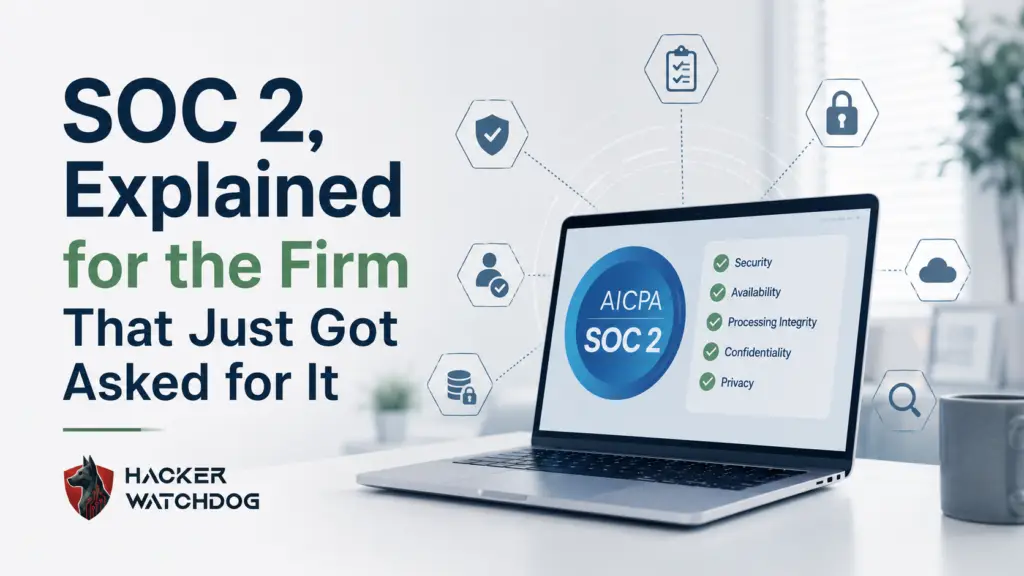
A SOC 2 report is an independent assessment that shows whether your firm has reasonable security controls in place to protect client data.
What is the difference between Type I and Type II?
How long does it take?
What’s the first thing to do?
Find out exactly what your client is requesting, then perform a gap assessment to understand where you stand today.
If you’re an accounting firm, law firm, consulting practice, or other professional services company, you may have experienced this moment:
A large client sends over a vendor questionnaire and asks for your SOC 2 report.
Your first reaction might be:
“Our firm isn’t a software company. Why do we need this?”
Fair question.
The reality is that many professional services firms handle sensitive client information every day. Financial records, legal documents, business strategies, employee data, and confidential communications all carry risk. As organizations strengthen their vendor management programs, they’re asking more third-party partners to demonstrate that security isn’t just something they talk about, it’s something they actively manage.
That’s where a SOC 2 report comes in.
Rather than taking your word for it, clients get independent validation that you’re protecting data responsibly.
The good news? Getting a SOC 2 report is usually much less scary than it first sounds.
A SOC 2 report is a security audit performed by a licensed CPA firm.
The audit reviews the processes, policies, and controls your organization uses to safeguard information.
Think of it like this:
If a client asks, “How do we know our data is safe with you?” a SOC 2 report provides a structured, independently verified answer.
Instead of explaining security one client at a time, the report gives prospects and existing clients confidence that your organization follows recognized security practices.
SOC 2 assessments typically focus on areas such as:
Most firms already have some of these practices in place. The challenge is often documenting them, formalizing them, and proving they’re consistently followed.
This is where people tend to get lost in acronym soup.
Let’s keep it simple.
SOC 2 Report Type I
A SOC 2 Type I report evaluates whether your security controls are designed appropriately on a specific date.
Think of it as:
“Do the right safeguards exist?”
The auditor reviews your policies, procedures, and controls to see whether they are reasonably designed to protect client data.
Type I is often a good starting point for organizations beginning their compliance journey.
SOC 2 Report Type II
A SOC 2 Type II report goes a step further.
The auditor evaluates whether your controls operated effectively over time.
Think of it as:
“Do the safeguards actually work consistently?”
Instead of reviewing a single moment in time, the auditor examines evidence collected across a review period, often several months.
Because it demonstrates ongoing effectiveness, Type II is generally considered the stronger and more widely requested report.
Which One Do Clients Usually Want?
Many enterprise clients specifically request a Type II report.
However, if you’re just beginning and a client needs evidence of security efforts quickly, a Type I report may help demonstrate progress while you work toward Type II.
The best approach is to ask the client what they actually require instead of assuming.
One of the most common questions we hear is:
“Can we get this done by next month?”
Maybe, but let’s set realistic expectations.
The timeline depends largely on your firm’s current security maturity.
Typical Timeline
SOC 2 Type I
SOC 2 Type II
If your firm already has solid security practices, the process tends to move much faster than expected.
If security documentation is scattered across different systems and spreadsheets, there may be more preparation work involved.
Before buying software or contacting auditors, take a breath.
Here’s the smartest sequence:
1. Clarify the Request
Ask the client:
Sometimes the requirement is more flexible than it initially appears.
2. Perform a Gap Assessment
A gap assessment compares your current security posture against SOC 2 expectations.
This quickly identifies:
Many firms discover they’re much closer than they thought.
3. Prioritize High-Impact Controls
Focus on foundational items first:
These controls provide significant security value regardless of compliance requirements.
4. Build a Realistic Roadmap
The goal isn’t to become perfect overnight.
The goal is to create a practical path toward obtaining the SOC 2 report your clients expect.
“We’re Too Small.”
Many small and mid-sized firms successfully achieve SOC 2 compliance.
Client expectations are increasingly based on data sensitivity, not company size.
“It’s Only for Tech Companies.”
SOC 2 started gaining popularity in the technology world, but it’s now common across professional services, legal, accounting, staffing, consulting, and other industries.
“We’ll Need to Rebuild Everything.”
Usually not.
Most organizations already have many required controls. The biggest gap is often documentation, consistency, and evidence collection.
A request for a SOC 2 report doesn’t mean you’ve done something wrong. In many cases, it’s simply a sign that you’re working with larger organizations that take vendor security seriously.
The key is not to panic.
Start by understanding what the client needs, assess your current security posture, and build a realistic plan. Most firms are farther along than they think, and with the right guidance, the process becomes much more manageable.
Get a Compliance Snapshot from Hacker Watchdog.
We’ll help you understand your current security posture, identify gaps, and create a practical roadmap toward the SOC 2 report your clients are asking for, without the confusion, jargon, or guesswork.
A SOC 2 report demonstrates that an organization has implemented security controls designed to protect customer information and manage risk.
Costs vary based on company size, complexity, readiness, and auditor selection. Readiness assessments and remediation efforts can significantly impact overall investment.
Yes. Phishing remains one of the most common ways healthcare organizations experience data breaches and unauthorized access to patient information.
Absolutely. Law firms frequently pursue SOC 2 assessments because they handle highly sensitive client information.
Yes. Accounting firms are increasingly obtaining SOC 2 reports to satisfy client security requirements and demonstrate trustworthiness.
This site is protected by reCAPTCHA and the Google Privacy Policy and Terms of Service apply.
Use our free Business Security Checklist to quickly identify common cybersecurity gaps and the practical steps your business can take to address them.
Enter your information below and we’ll email the free checklist directly to you.
By submitting this form, you agree to receive the requested resource and occasional communications from Hacker Watchdog. You can unsubscribe at any time. Your information will be handled in accordance with our Privacy Policy.
Learn how scammers manipulate people into giving up money, passwords, and personal information with our free Scam Defence Workshop.
Enter your information below and we’ll email the free workshop directly to you.
By submitting this form, you agree to receive the requested resource and occasional communications from Hacker Watchdog. You can unsubscribe at any time. Your information will be handled in accordance with our Privacy Policy.
Download our free Individual Online Banking Hygiene Guide and learn simple, practical steps to protect your accounts, personal information, and money from common online threats.
Enter your information below and we’ll email the free guide directly to you.
By submitting this form, you agree to receive the requested resource and occasional communications from Hacker Watchdog. You can unsubscribe at any time. Your information will be handled in accordance with our Privacy Policy.
By clicking “Accept All" button, you agree to the storing of cookies on your device to enhance site navigation, analyze site usage, and assist in our marketing efforts. Privacy Policy Cookie Policy